Showing posts with label to the extreme. Show all posts

Thursday, February 13, 2025

The Slinging Detective

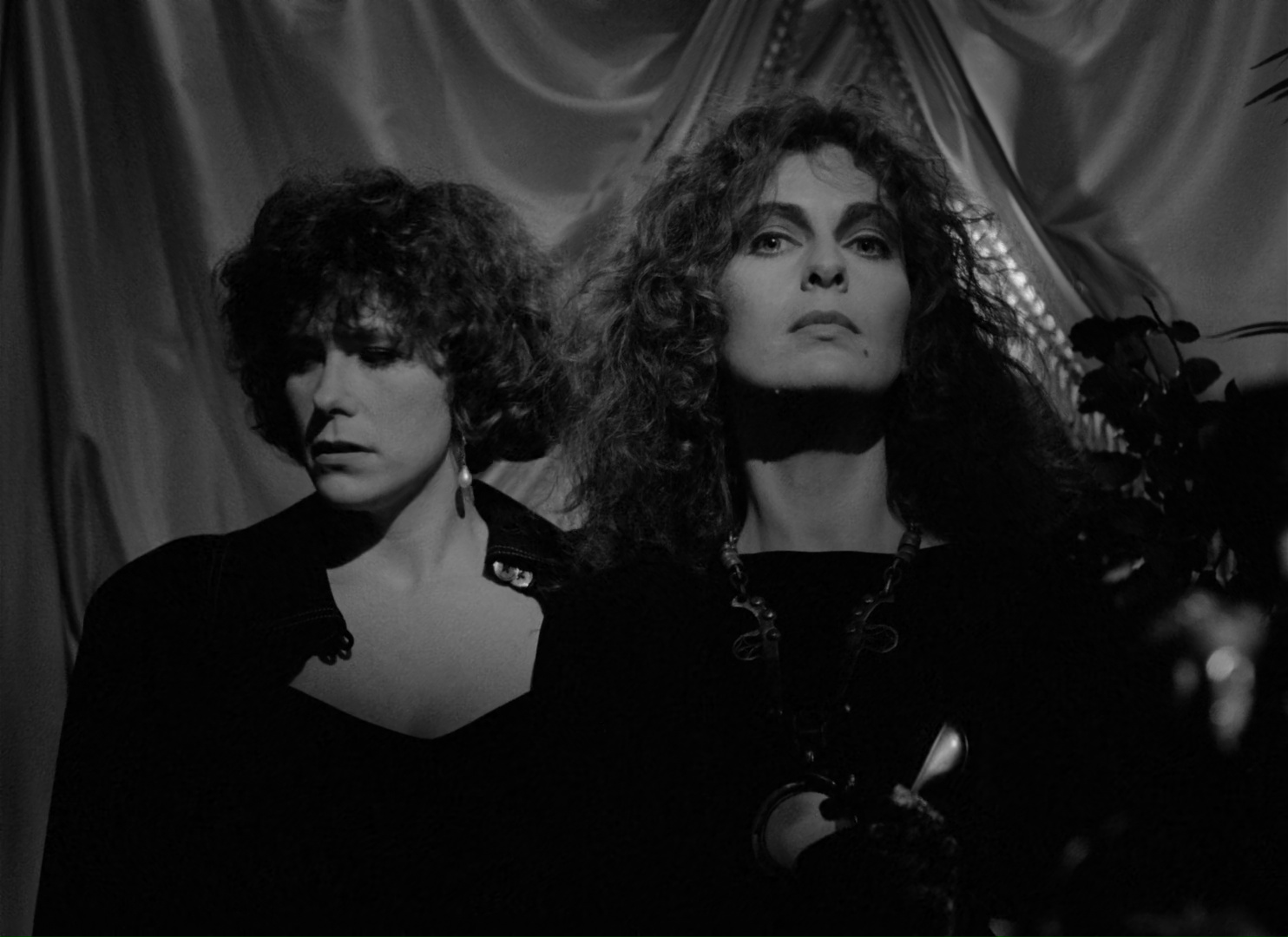
Singapore Sling (Nikos Nikolaidis, 1990)

Preceding the Greek Weird Wave movement, which rose to prominence in the late 2000s, Nikos Nikolaidis's thoroughly depraved Singapore Sling (1990) can be considered as ahead of its time. Ought to add, I've largely found Greek Weird Wave (which turned Yorgos Lanthimos into a popular name amongst the kino massive) a pretentious and farcical movement, thanks to its trademark stilted deliveries and awkward hipster humour. Singapore Sling happens to be something of an outlier in this regard, as it manages to have its own idiosyncratic charm and identity without it being eye-rollingly trying too hard. As a result, it happens to be a rewatchable entry in extreme cinema rather than a one time endurance test.

Singapore Sling, or to use the literal English translation of its original title - The Man Who Loved A Corpse, takes obvious inspiration from Otto Preminger's celebrated noir Laura (1944). Preminger's film has  Dana Andrews's private dick searching for the killer of Gene Tierney's character, before a big twist surfaces later in the movie. Nikolaidis has Singapore Sling, the eponymous, Greek detective searching for his lover Laura. The sleuth stumbles upon a bizarre mother and daughter disposing of a body during a torrential downpour, who might know something about Laura's whereabouts.

Many familiar tropes and cliches associated with film noir are prominent in the film. The most obvious is the titular character being the detective investigating the disappearance of his sweetheart. From the harsh black and white contrast lighting, to Sling's first person narration (albeit in Greek), there's a level of technical understanding for the genre's craft. Without the odd giveaway, such as a very obvious '80s looking turntable, you would be forgiven for mistaking the film as being from a much earlier era. That is of course if depraved movies of the Forties and Fifties were on par with this back then. It's what makes Singapore Sling so anachronistically abstract.

Be warned; Singapore Sling definitely falls under the extreme cinema umbrella. This is a film which isn't shy in showing numerous acts of sexual depravity like BDSM and various bodily fluids. There are wince inducing moments of vomiting during a greedy feast scene, but perhaps the film's piece de resistance is the scene involving a kiwi fruit. Without delving into any graphic detail, you'll never see the fuzzy fruit in the same way again. Ever.

What's intriguing about the film, for me at least, is the relationship between Daughter AKA Laura (Meredyth Herold) and Mother (Michele Valley). Given how intentionally unreliable and contradictory facts and details are presented, you aren't certain if the characters are related, or if it's all role play. This does add another layer to the film, which sends the mind racing into overtime attempting to make sense of the characters.

Performance wise, both Herold and Valley are superbly animated and quirky as the psycho mother and daughter. They are what makes this such a watchable film. Thanassoulis plays it lifelessly deadpan, but there's more to his character as the film progresses. He's plainly not a third wheel in the film's plot. To be fair, Singapore Sling's group psychopathy has a lot in common with Freddie Francis's absolutely stellar Mumsy, Nanny, Sonny & Girly (1970), another film that I adore involving a role playing dysfunctional family.

Definitely not for everyone and obviously one for the sickos. A technically stylish and well crafted film considering how depraved it is from the jump. It's oddly strange how various tropes and cliches associated with film noir are grafted into such a perverse art-house film. This make it all the more audacious. A  transgressive film, and one that's grown on me even more over the years.

Amazingly, Singapore Sling is available to watch for free and uncut on Nikos Nikolaidis's YouTube channel. How it hasn't been taken down by Google, I'll never know. However, I do welcome it being there for any inquisitive film fanatics daring enough to check it out. More recently, Singapore Sling got the lavish boutique Blu-Ray treatment, courtesy of Vinegar Syndrome, which I ended up purchasing for my own film library.

Tuesday, November 28, 2023

Children of the Corned Beef

When Evil Lurks (Demián Rugna, 2023)

Hollywood has commonly been lacking the required mean-spirited streak to appease desensitised fans of  horror cinema. In order to cast a net and attract the majority, the output is usually safe, soft and homogenised. Thankfully, there are foreign and independent film makers out there to counter the Disneyfied dross being churned out; Rob Jabbaz's The Sadness (2021/2022) and Damian Leone's Terrifier 2 (2023) are recent examples. Argentinian film maker Demián Rugna's When Evil Lurks (2023) is the latest to balance the scales with what's probably the best horror film of the year.

When Evil Lurks stands out from many of its peers for having the cojones to have all its characters as fair game to the horrors that unfold. As a result, it's still shocking when certain scenes are acutely telemarked and still landing a haymaker on your senses. This is a deeply nihilistic film; evoking the anything goes attitude of 1970s horror like Who Can Kill a Child? (1976). There is no safety barrier, it's pure destructive brutality. Critics will list some of Lucio Fulci's films as obvious inspirations, but I spotted traces of other notable horror films, such as Prince of Darkness (1987) and Hereditary (2018) in there, too.

Set in a rural Argentenian province where folks are deeply superstitious, the film's two major characters; brothers Pedro (Ezequiel Rodríguez) and Jimi (Demián Salomón) encounter a grossly bloated individual named Uriel, who is said to be one of the rotten. This is the colloquial term for demonically possessed. The brothers, along with neighbouring land owner Ruiz (Luis Ziembrowski), are given the unenviable task of dealing with Uriel. Like every horror film, things don't go to plan. 

The film introduces seven golden rules which must be adhered to when dealing with the rotten. If they aren't dealt with properly, and more importanly, by an expert, then the demonic evil spreads. Thankfully, with this being a horror film, the rules are constantly broken. As beasts and humans are possessed this allows Rugna to showcase some shockingly extreme moments that you don't see very often in contemporary horror. It's almost farcical watching Pedro making bad decision after bad decision and leaving a trail of death in his wake, but they do lend to a compelling film. Children being subjected to either being victims or perpretators are easily the most disturbing highlights of the film. One scene involving a mother carrying her infant son along a road is pure nightmare fuel. Definitely not something that will be forgotten easily.

It's not a perfect film, however. When Evil Lurks can feel disjointed at times, as it plays a balancing act with its cumbersome handling of multiple characters and locations for the sake of keeping everything breezy, along with a second ending that feels almost trivial in comparison to what occurs earlier. Still, these flaws don't ruin the film, as Rugna's main focus seems to be all about bringing back some utterly nihilistic and misanthropic brutality that's evidently missing in many of today's contemporary horror films. As such, the film is a triumphant success.

Really hope the film gets a physical release and not rot on Shudder like Deadstream (2022) has been doing in my region.

Thursday, September 28, 2023

The Sisters of No Mercy

A Gun for Jennifer (Todd Morris, 1997)

Travel back in time with me to the mid-nineties, where lads mags reigned supreme and feminist pop anthems were tailor made to gullible young girls by corporate fat cats, but for fellow psychotronik film heads, they might have chanced upon the mere whisper of A Gun for Jennifer (1997). Part of the New York underground film scene, Morris' film is a grimy faux-grindhouse actioner that harkens back to Abel Ferrara's early films and Jim Van Bebber's Deadbeat at Dawn (1988). A Gun for Jennifer is a punk, feminist fantasy that's far removed from the attractive doll squads you might find in a Ted V. Mikels or Roger Corman production. What we have here are the spiritual daughters of I Spit on Your Grave's dick-severing protagonist, Jennifer Hills. A Gun for Jennifer is a mean and scuzzy film that embodies the dirty New York grunge from the seventies and early eighties.

Co-written by its titular lead, Deborah Twiss, who you might recognise as the hot for teacher Mrs. Zane from Kick-Ass (2010), she managed to include her personal experiences when she worked as a dancer in a strip bar into the film. Additionally, these were followed up with her personal fantasies of beating up unruly and way too handsy patrons. One scene in particular creatively shows where to put a pool cue where it doesn't belong. Based on interviews by Twiss, much of the screenplay was written by her, other than the cop scenes which were penned by Morris. The end result is a staggeringly violent vigilante film.

Abused runaway housewife Alison (Deborah Twiss) comes to the big city of dreams and finds out everything in New York ain't always what it seems when she's assaulted by a couple of low lifes intent on raping her.  She's saved by a vigilante squad of women led by their misandrist and psychopathic leader Jesse (Freida Hoops). She's forced to pull the trigger on one of her muggers and become part of the murderous crew, otherwise it's a similar fate for her. Thus, Alison adopts the name Jennifer as her new reborn incarnation and adjusts to life working as a strip bar waitress in The Widows' Den. Her extra curricular activities involve going to punk gigs where a top less band singer pulls out a prosthetic dick from her pants that she mutilates with a knife, and constantly being caught in the crossfire of her gal pals' escalating shooting sprees. The finale involves an ultra bloody shootout with some big time Jeffrey Epstein type villain and his heavies.

Revisiting this film in a post #MeToo world has brought about two interesting observations I hadn't noticed before: A Gun for Jennifer goes against the popular belief held by various prominent film critics that the vigilante subgenre is tailored towards a right wing audience; also, how crazy is it that a crude and thoroughly cartoonish indie film from the nineties contains a better grasp of female character writing than the indestructable Disney princesses who undeservedly reign today?

Despite its notoriety, A Gun for Jennifer is a relatively obscure film, but it seems like the movie gods have smiled upon your host's wish list with another accurate prediction as Deborah Twiss spilt the beans over a forthcoming release from Vinegar Syndrome (although, she was wrong about the July release date, sadly). Either way, it's more a gift than a curse, as it's one of those really sought after films that I'm thankful I still own on DVD. Cue a massive influx of horrendous attention seeking reviews by social media narcissists when the eventual rerelease does occur, however. 

A Gun for Jennifer (Trailer)
Todd Morris, 1997

A Gun for Jennifer is very much a rough diamond, but essential viewing for anyone that might be interested in nineties indie film and bloody violent cinema.

Thursday, December 8, 2022

Down with the Sickness

The Sadness (Rob Jabbaz, 2021/2022)

Feeling confident to share that I've pretty much seen what 2022's movies had to offer; or at the very least, anything that was of interest to me. Therefore, it's time to make things right by spending a bit of time discussing Rob Jabbaz's Taiwanese gorefest, The Sadness (2022) from earlier in the year. Sticklers for precise film release dates might class this as one of last year's movies, but The Sadness only made its way to most people's radars this year.

The Sadness is the type of depraved horror film that's far too brutal and sadistic for even today's mainstream horror standards. It's remarkable how a pandemic can turn the world on its head and in the case of The Sadness, it's within a blink of an eye. Its breezey pace kicks in relatively early and doesn't really let up until around the big finale. Jabbaz's film is essentially a showstopper of misanthropic nihilism and brutal depravity; seldom seen to this degree. Another example of the type of product that Hollywood won't or cant produce! What's equally amazing is that it was funded via cryptocurrency and a camgirl business. Twitch thots - take note!

The premise itself is the standard outbreak formula; which hardly makes it groundbreaking. You've seen it all before; albeit with some not so subtle allegories to COVID-19 and vaccinations. The film's young couple are your typical template, but they do thankfully become compelling enough to make the viewer feel invested in their plight throughout the progress of the film. Comic book heads are right to make comparisons to Garth Ennis' Crossed. Not meaning to come off as a contrarian, but I wasn't a fan of those ploddingly-paced, The Walking Dead style books. To its credit, Jabbaz's The Sadness condenses shocking depravity in ninety-nine minutes without having to make me wait long and that's probably a good reason why I don't mind its flawed writing so much. Delving into any further details about the film won't attract nor repel anyone since it's the type of extreme film where you just know whether this is for you or not. The Sadness is definitely for me.

Horror snobs might turn their noses at The Sadness for not fitting into the pompous category known as "elevated horror", but this was one of the most entertaining and engrossing outbreak/zombie films for your host since maybe Train to Busan (2016). Despite its faults, it really delivered in the entertainment department, and for that it get a respective nod from me, regardless.

The Sadness (Restaurant scene)
Rob Jabbaz, 2022