Showing posts with label italian horror. Show all posts

Monday, March 3, 2025

What an Excellent Day for an Iconoclasm

The Demon (Brunello Rondi, 1963)

Alarm bells tend to ring for me whenever a film is labelled as neorealism. There's nothing remotely real about them for me. Hence, going into Brunello Rondi's The Demon (AKA Il Demonio, 1963) came with a degree of hesitation. Thankfully, the frequent Federico Fellini (AKA Tinto Brass without all the smut) collaborator managed to bypass my defences with a compelling and virtual documentary like film set in the peasant confines of Lucania, Southern Italy. The Demon distinguishes itself from the cut and paste Bava-esque gothic horrors from this era by drawing a series of damning parallels between peasant superstitions to that of the Catholic church. The film would subsequently be banned by the Italian censors. A huge shame, as it's an excellent film from the Italian horror canon of the 1960s.

Allegedly based on a "recent, tragic true story" The Demon tells the tale of Purificazione (Daliah Lahvi), Purif for short, a beautiful peasant woman who is driven to madness and obsession after being given the push from her lover Antonio (Frank Wolff). Antonio is something of a player, as he's been seeing Purif on the side whilst engaged to another woman (a monumental downgrade in the looks department). The rejected woman's behaviour results with her becoming increasingly ostracised by both her superstitious family and Lucania's townsfolk. One example has her throwing a dead cat outside Antonio's home, making everyone think she is might be a witch or possibly possessed by the Devil. 

What's engrossing about The Demon is witnessing how the bizarre and superstitious customs of the townspeople are being equally as disturbing as Purif's actions. Before even getting to consecrate their marriage, Antonio and his bride are made to wait outside their bedroom while the elders prepare the room. A scythe is placed under the newly wed's bed ("to cut Death's legs."), while dried raisins are scattered in the form of a cross over the sheets to absorb any evil. Another scene involves Purif and other folk carrying heavy rocks to the town centre to metaphorically unload their sins. Each individual confessing their sin; from stealing a chicken, to having incestuous desires with their children. What a messed up town.

With such a restrictive and highly superstitious belief system, this makes Purif a sympathetic character in The Demon to a degree, as she is constantly treated cruelly by others for being perceived as evil. This is strikingly similar to Florinda Balkon's tragic witch lady from Lucio Fulci's Don't Torture a Duckling (1972). At one point, Purif is accused of straying the soul of a sick boy from drinking water leading to his death. She is beaten by her father. In another instance she is hog-tied and raped by a shepherd. A revered, local shaman is equally as bad as he sexually assaults her while masquerading in attempting to rid her demonic possession. These terrible events culminate to an unforgettable scene where Purif is desperately given the exorcism treatment by a Catholic priest in a church. Lavi's dancing experience pays off, as she spider walks for what is perhaps the most disturbing point in the film. Possibly inspiring the infamous deleted scene from William Friedkin's horror masterpiece in The Exorcist (1973).

Daliah Lavi's exotic looks and powerhouse performance are an irrevocable eye opener. Her role in Mario Bava's beautifully gothic and supernatural S&M The Whip and the Body (1963) was a real standout amongst her obviously-there-as-eye-candy roles elsewhere. Numerous camp '60s films such as James Bond cash-in O.G. Casino Royale (1967) and James Bond clone Some Girls Do (1969) are perfect examples of her talents being wasted, in all honesty. The Israeli soldier turned actress was essentially seen as the Gal Gadot of her era, sadly. In The Demon, however, she at least flexes some real acting prowess, fortunately. Lavi is mesmerising in her role. According to the late actress, this was her favourite role in her film career and understandably so.

Other than Daliah Lavi, American actor, Frank Wolff is the only other actor with the most screen time, as he is both the catalyst and antagonist in the film. Considering how insane Purif is, to the point that the townsfolk believe she is possessed, it's hard to be sympathetic to his character whilst he is taking advantage of her during her worsening state. Wolff appeared in countless Italian films; particularly spaghetti westerns. Perhaps his most recognisable role is his moustachioed Brett McBain, in a harrowing scene where he and his family are massacred by Henry Fonda's gang in Sergio Leone's all-time classic Once Upon a Time in the West (1968). Personally, I'm even more traumatised from the scene where he's turned on by Nieves Navarro seductively eating grilled fish in Luciano Ercoli's giallo Death Walks on High Heels (1971). (I'm totally aware the grammar of that film title is wrong. Blame the film makers!)

Carlo Bellero's lush black and white cinematography in The Demon manages to capture the ambience of Italian gothic horror while his documentary style footage of various religious traditions and customs appear like they're lifted from a vintage mondo film. That would explain why this formerly obscure Italian folk horror is sometimes tagged as neorealism, in some respect. A far more successful blending of two filmic treatments in comparison to Luigi Bazzoni and Franco Rossellini's convoluted, rustic giallo The Possessed (1965), which is obviously inspired by the look of Michelangelo Antonioni's films.

Didn't have any major gripes with The Demon, but I did find the whole convent scene before the climax of the film a tad trivial. Purif's previous run-ins with the clergy were effectively realised prior, so her brief time with the fearful nuns felt like unnecessary padding. Still, Purif's run-in with the nuns does result in some breathtaking scenery outside of the convent. The scene where Purif walks through a barb wire fence around a sacred tree being obviously symbolic.

As a staunch defender of exploitation films in general, it's somewhat disappointing Rondi went that direction. Any director who delivers a thought-provoking, subversive and beautifully crafted film like The Demon and to later helm sexploitation films like Sex Life in a Women's Prison (1974) and Black Emanuelle, White Emanuelle (1976) kind of missed their chance at being a world class director, to be honest.

Another gem from Severin's legendary All the Haunts Be Ours: A Compendium of Folk Horror Vol. 1; a box set that's still too expensive for me. However, I have managed to cover some great films from the collection which I eventually discovered down the line: Alison's Birthday (1981) Eyes of Fire (1983) and Celia (1989). The Demon is objectively the best film I've watched so far, which makes the set even more desirable than before. It's also another fine example why physical media is so important, since The Demon is rescued from relative obscurity and readily available for today's film aficionados with a penchant for world cinema and folk horror.

Wednesday, February 5, 2025

Of Death, of Love

Dellamorte Dellamore (Michele Soavi, 1994)

Largely considered as the last great Italian Horror by film critics and genre enthusiasts, Michele Soavi's darkly comic Dellamorte Delllamore (AKA Cemetery Man, 1994), is both a surreal and unconventional offering bound to frustrate and confuse anyone mistaken into thinking this would be another gory, flesh eating, Italian zombie flick in the vein of Zombi 2 (1979) or Burial Ground: The Nights of Terror (1981). While commonly described as an existential zombie film, it's only partially accurate, as the zombies, or "returners" as called by the film's protagonist, are only prominent in the first half of the film. The remainder is a descent into madness, where the living are the bigger focus of the story. Culminating with an ambiguous ending, that's open to all sorts of interpretation.

Gianni Romni's screenplay is an adaptation of the novel of the same name, penned by author and comic book writer Tiziano Sclavi. The book was a prequel to Dylan Dog, a cult Italian comic storied around an English, paranormal investigator. Artist and co-creator, Angelo Stano based his on the titular character on the English thespian Rupert Everett, after seeing him in the drama Another Country (1984). Flattered by the use of his image and the general premise of Dellamorte Dellamore, Everett's eagerness and involvement in the film's pre-production came very early on.

On the outskirts of Buffalora, a rustic town in northern Italy, the chronically depressed Francesco Dellamorte is the caretaker of the nearby cemetery, which is besieged with the select undead who rise from their graves seven days after their burial. The thirty-something protagonist, who has more in common with an emo teenager, is accompanied by an almost mute (the only thing he utters is, "Gna!" and in typical Lassie fashion, its meaning is understood by Dellamorte), spherically-shaped manchild known as Gnaghi (François Hadji-Lazaro). Together, they deal with the returners like a humorous odd couple burdened with the most mundane of tasks. Interestingly, Dellamorte is a bit of a pretentious prat with his depressed poetic drivel and confessing to only reading the telephone book. His cellar dwelling companion, however, likes nothing more than consuming plates of spaghetti with bread and watching war footage on his beloved TV.

Their dynamic changes with the introductions of She (the stone cold, Finnish Italian fox Anna Falchi). The buxom bombshell plays three different, but identical looking women (technically four if you count her returner form). The first is a beautiful, young widow with a penchant for the ossuary. The second is the second mayor's secretary with a fear of male genitalia. The final version of She is a college student who turns out to be a prostitute. All three of these incarnations have a profound effect on Francesco Dellamorte's mental state. Ultimately, turning him into a man who no longer kills the dead, but the living. As shown when the Grim Reaper appears and tells Dellamorte, "Stop killing the dead. They're mine. If you don't want the dead coming back to life, why don't you just kill the living, shoot them in the head? Are you listening to me?" Indeed he does, as he eventually drives into town and goes on a killing spree; shooting the local youths who mocked him for supposedly being impotent.

Structurally, Dellamorte Dellamore is top heavy (not a pun on Falchi's fantastic topless scenes*) as the first incarnation of She consumes the first hour of the film. The other versions of the alluring femme and their impact in the film, run far shorter. They're all pivotal, however, as they're key triggers to the decline of Dellamorte's deteriorating mental state. There is of course Gnagi's sideplot, where he falls for the career obsessed mayor's daughter. Dead or alive; she's still only fourteen years old, regardless of Gnagi believing he is also a child. Back on topic, the film does manage to work really well, despite its absurdity. It's largely due to its uniqueness and its surreal, dreamlike quality; everything feels and behaves so out-of-wack, that any flaw might come across as intentional by Michele Soavi. A notable reason why Dellamorte Dellamore is given the clichéd description as being Lynchian. Although, Italain horror has always had its own eccentricities and general weirdness well before the term was ever coined.

In terms of the film's visual style, it's a veritable mix of vintage Sam Raimi and early Peter Jackson; particularly many of the nocturnal graveyard scenes. Mauro Marchetti's stunning cinematography easily elevates the film above most other '90s horror films, let alone the barely functioning Italian horror industry at the time. Soavi, a fan of classic fine art and recreating them in his films, creates a homage to one during the ossuary scene, where Dellamorte has his head wrapped in a scarf, passionately kissing a veiled She; an obvious reference to Rene Magritte's The Lovers II. Other films also get the referential treatmentl  the most blatant being the snow globe from Orson Welles's Citizen Kane (1941). A totally obscure one, is Dellamorte constantly mistaken for an engineer; a reference to David Hemming's character in Dario Argento's Deep Red (1975). Of course, Soavi was no stranger to referencing grand pieces of art with his directorial debut, the Euro-slasher Stagefright (1987); a classic horror in its own right.

Perhaps the film's greatest achievement is Rupert Everett being in it, playing it thoroughly emo, yet defying the odds and being the superb lead. Easily his best film. Witnessing him shoot dumdum bullets into the undead while acting thoroughly morose is how I would imagine Ash J. William would be if he was a poncey English bloke. Everett is also the common element that keeps the film flowing and compelling, regardless of its incoherent plot. He bridges all the on-screen insanity from one scene to the next, from his comedic scenes with Hadji-Lazaro's Gnagi, to his doomed romances with Falchi's multiples of She; it's thoroughly entertaining.

Bottom line - Dellamorte Dellamore is a classic, yet sadly perfect swan song as the last great Italian horror. It's also tragic Soavi never helmed any other theatrical films afterwards and retreated into TV work, as he stepped out of the shadow of being Dario Argento's protégé and proved to possess his own unique style and talent. The Italian film industry was in dire straits at the time, and all the great directors were well past their primes, which makes Soavi an important name in the canon of Italian horror for being responsible for its last great entry.

*Can't link any of the multiple screenshots I took of Anna Falchi's topless scenes as Imgur deleted them. The philistines.

Tuesday, June 18, 2024

Nasty Habit

Killer Nun (Trailer)
Giulio Berruti, 1979

Swedish bombshell Anita Ekberg frolicking in the Trevi fountain in Federico Fellini's La Dolce Vita (1960) might be peak cinema to snobbish cinephiles, but she'll be remembered as a drug addicted, dentures-stomping, horny nun in Giulio Berruti's nunsploitation/giallo and one time video nasty, Killer Nun (1979) by film degenerates like myself. At the risk of offending both sides of the kino taste spectrum, I can't say I'm a fan of either of those films. However, one particular track featured on Killer Nun by composer Alessandro Alessandroni has been a fave of mine for many years; which at least makes it somewhat redeemable.

Alessandro Alessandroni - Suor Omicidi, Seq. 4
 Killer Nun/The Strangler of Vienna/Lady Frankenstein compilation, 1999
 

Something about Suor Omicidi, Seq. 4's jangly acoustic guitar strumming away while the sounds of an ominous choral build in the background, concluding with a manic church organ, really does it for me. Little wonder it’s amongst my favourite giallo tracks of all time.

Killer Nun's soundtrack didn't get a vinyl release until twenty years later. The tracks finally appeared in an Alessandroni compilation containing two other scores of his: Lady Frankenstein (1971) and The Strangler of Vienna (1971). The latter, I have yet to see.

Lady Frankenstein (Trailer)
Mel Welles & Aureliano Luppi, 1971
 

From Orson Welles to Mel Welles; you know Joseph Cotten's career hit an even greater decline than Anita Ekberg's when he went from Citizen Kane (1941), Shadow of a Doubt (1943) and The Third Man (1949) to Italian horror Lady Frankenstein; a far cry from his classic earlier body of work. Far more entertaining than Killer Nun and La Dolce Vita, though.

Tuesday, February 13, 2024

Signora Weaver

The Spider Labyrinth (Gianfranco Giagni, 1988)

The tragedy of Italian Horror will always be its finite lifespan. Michele Soavi's existential zombiefest, Dellamorte Dellamore (1994), was arguably the last classic entry before it all died. Revisiting various other Italian Horror films from around this era feels like you're attending a coroner's inquiry at times. With all that out of the way, we come to the first great Italian Horror film I've discovered in Lord knows how long. Gianfranco Giagni's obscure debut and one and only horror film, The Spider Labyrinth (1988), is a rare anomaly. What's equally remarkable about it, is the fact I didn't know of its existence until it was announced as a 4K UHD release by Severin Films late last year.


Professor of Oriental Langauages, Alan Whitmore (Roland Wybenga) is sent on assignment to Budapest by his superiors to meet with fellow researcher, Dr. Leo Roth (Attila Lõte), after going excommunicado during his work on the Intextus Project. While there, Whitmore is warned by various folk, including a mysterious stranger played by spaghettic western veteran William Berger, to leave the Hungarian capital as his life is at stake. During the first half of the film, the Hitchcockian vibe is more than evident, evoking James Stewart's quintessential fish out of water from The Man Who Knew Too Much (1956). Furthermore, the film comes replete with an atmospheric Bernard Hermann style score courtesy of its composer Franco Piersanti. Similarly, there's an obvious gothic aesthetic to the film as it incorporates the beautiful old world vista of Budapest along with stuffy, dimly lit set interiors. These elements lend well to the slowburn mystery aspect before it adopts more familar horror territory.

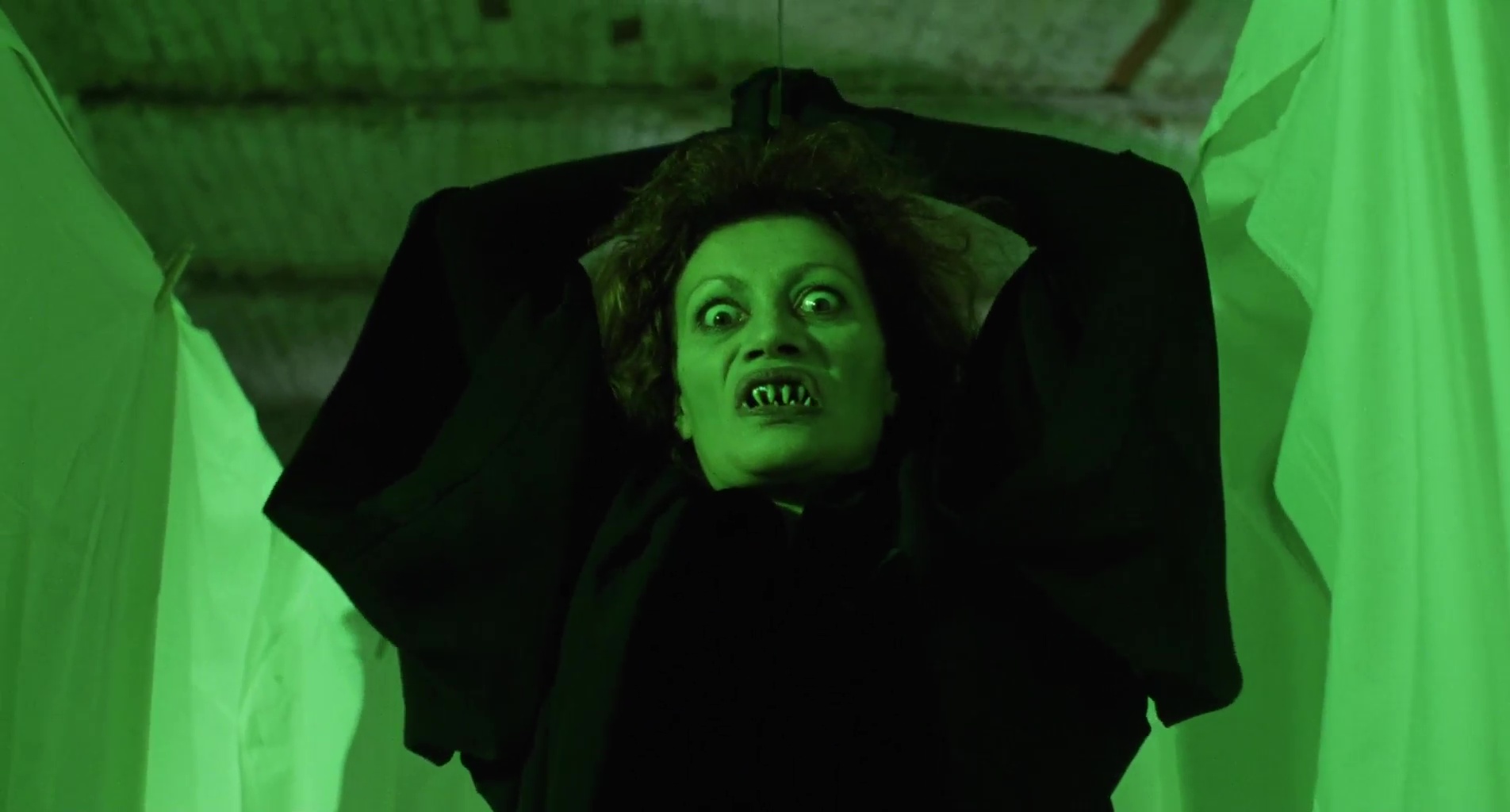
Events really kicks off when a killer resembling Faye Dunaway in Supergirl (1984) with dodgy chompers, begins dispatching various folk by drooling over them with her web drool and then fatally stabbing them. Pick of the bunch, is Maria (Claudia Muzii), a hotel maid who winds up with a knife in her skull during a stunning set piece which is obviously inspired by Suspiria thanks to the numerous on screen props and its colour palette.


Roland Wybenga's performance might come across a little wooden, especially as he lacks the emotional range of the far talented James Stewart, but the supporting cast are rather good and help compensate this issue. The best performance being played by Stéphane Audran as Mrs. Kuhn, the sinister manageress and owner of Hotel Starvas. There's also Paola Rinaldi, who is effective as Dr. Roth's assistant, Genevieve Weiss. She's great as the seductive femme fatale, having you second guessing where her allegiances really lie.

Nino Celeste's cinematography is absolutely gorgeous and major highlight of the film; the Argento-esque scenes are particularly breathtaking. Considering its low budget, the film is stunning to look at from start to finish; a stark contrast to some of the other Italian Horror films from the late eighties. Its aesthetic beauty is definitely a reason why I'm smitten by this film.


Love the Lovecraftian theme involving an ancient cult of spider worshippers known as the Weavers. This revelation instills paranoia and fear upon Whitmore, who just so happens to be an arachnophobic. For fans of horror, it's an intriguing concept which spoils us rotten with fantastic subterranean locations and a scene which borrows very heavily from Rob Bottin's legendary and unsurpassed effects work from The Thing (1982). Sergio Stivaletti's attempt at replicating Bottin comes across a Lidl equivalent, sadly. On a positive tip, that's a fairly minor issue as the rest of the effects are very good; particularly found the stop motion spider scenes very endearing as they evoked vintage Ray Harryhausen greatness.

Legitimately shocked that I had no prior knowledge of The Spider Labyrinth's existence until recently. Definitely deserves a spot as one of the best late game Italian Horror films, in my honest opinion. An absolute treat of a film. So glad it's been rescued from obscurity. Makes me wonder if there are any other lost Italian Horror gems out there awaiting discovery.

Saturday, November 11, 2023

Lost in Reincarnation

Black Magic Rites (Renato Polselli, 1973)

Many moons ago, I foolishly bought a Danish DVD of Renato Polselli's follow-up to his ultra sleazy giallo Delirum (1972) without realising there weren't any English subtitles for it. Black Magic Rites (1973), AKA The Reincarnation of Isabel, was way more obscure back then, and your host was desperate to check it out on account of its reputation of being completely insane. With complete naivety, I figured I could at least cobble together a semblance of the film's plot according to the actions on screen. No chance! Gave up very early into the film as I didn't have a clue what the hell was going on. Fast forward to the present day and Indicator Films has released a very lavish 4K UHD of the film; more importanly it has English subtitles! Turns out the film gods struck their cruel blow upon me once more as Black Magic Rites is still an incomprehensible film even with the subtitles.

I wasn't alone in finding Black Magic Rites a confusing experience, both critics, David Flint and Kim Newman, were equally perplexed by it when I rewatched it with their commentary. It became all the more amusing with them trying to keep their professional composure during the film's excessive moments of unbridled sleaze and gory sacrificial goings on. Stephen Thrower, AKA Jess Franco's #1 Stan, who can talk a good one regarding the Spanish pervy midget's softcore Eurotrash films being neglected cinematic masterpieces, was equally as befuddled with Polselli's opus as the rest of us. What is an absolute certainty, is the unified acknowlegment that Black Magic Rites is a thoroughly entertaining psychedelic acid trip for die hard fans of Italian exploitation cinema.

I wonder if Peter Strickland's fictional movie The Equestrian Vortex from Berberian Sound Studio (2012) was inspired by Black Magic Rites.

As far as the main plot goes, Black Magic Rites appears to revolve around a collective of vampires performing Satanic sacrifices to resurrect a buxom witch and Dracula's beloved known as Isobel (Rita Calderoni). With the aid of choppy editing, the viewer is repeatedly transported from the fourteenth century to the modern day (the 1970s, in this case), to the point you're flummoxed with what time period certain scenes are set. Equally confusing are the cast (many from Delirium) appearing in both eras as reincarnated descendents of the angry mob who witness Isobel's burning at the stake. Extremely out there seventies clothes and hairstyles also muddy the waters as you're still left wondering if the scene you're watching is set in the Middle Ages or the decade that taste forgot.

Despite all these bewildering factors, Black Magic Rites is a deeply alluring oddity for anyone vested in Italian horror: on the one hand it starts off as a retread of Mario Bava's The Mask of Satan (1960), AKA Black Sunday; while on the other, it's a hallucinogenic departure form any sense of normality. You're never really sure whether the red body stocking clad vampires are performing their sacrificial rituals in a dungeon below the film's gorgeous castle - the same one from Massimo Pupillo's Bloody Pit of Horror (1965) - or in some kind of dimensional limbo. They're my favourite scenes from the film; gruesome as they are, they look gorgeous thanks to their technicolour lighting and jet black backgrounds; bizarrely reminding me of a school disco. Stylistically, the film evokes the ethereal and erotica vibes found in Jean Rollin's works, and also the influence of celebrity Satanist Anton LaVey. Coincidentally, LaVey used to mingle with the actress Jane Mansfield, who was once married to the film's male lead Mickey Hargitay.

Italian horror tends to be perceived as part of the wild and wacky side of horror cinema, and in Black Magic Rites' case it's more than undeniable. I've seen more than my fair share of utterly batshit Italian horror and Polselli's film has to be one of the more out there offerings. Much of it is inexplicable, e.g. why does one of the characters have a hilarious facial twitch? Even the film's dialogue, which was also written by Polselli, is abstract; lines like, "Vampires need blood that's not contaminated by human semen" doesn't make a shred of sense. The only real restraint is Gianfranco Reverberi's melodic, yet tame score. Imagine if the ritual scenes had a similar dark hippie vibe like what Bruno Nicolai delivered for the cultist scenes from Sergio Martino's All the Colours of the Dark (1972).

It's not often when a genre film I can barely understand wins me over this way. Most tend to fail and come off as pretentious art house in sheep's clothing. Black Magic Rites is a phantasmagoric and captivating entry in genuine Italian horror canon, which explains why it's so appealing despite its incoherentness.