Showing posts with label eighties. Show all posts

Wednesday, August 12, 2026

Beastly Behaviour

Marquis (Henri Xhonneux, 1989)

Portrayals of historical figures or past events on film can often stray from the truth. Perhaps it's for creative reasons. Whether to offer a different perspective, subvert expectations, or appeal to a contemporary audience, historical facts can potentially be susceptible to being revised. Take the French nobleman and libertine writer Donatien Alphonse François, better known as the Marquis de Sade. His association with blasphemy, perversity and depravity is so well known that his very name is now a part of our lexicon to describe people who seek pleasure from those pursuits (and it's the professional name of the Soul singer Helen Folasade Adu, might I add). Therefore, it is somewhat disconcerting whenever de Sade is depicted in popular culture with a sense of romanticism as a sort of free speech activist. A bit like the contemporary view amongst 21st-century nerds that Velma Dinkley is more attractive than Daphne Blake.

Belgian director Henri Xhonneux (what an awesome surname) and his French co-screenwriter Roland Topor adopt this revisionism, and take it a step even further with an unorthodox approach on the libertine pervert in their 1989 film Marquis. What makes their idolised offering unique, is the use of anthropomorphic animals portraying all the characters. Actors wearing striking animal based animatronic masks, and partaking in acts unsuitable for Sunday afternoon television, make this an appealing proposition for purveyors of out-there cinema. Disney, this is not. Furthermore, our eponymous protagonist, played by François Marthouret, resembles a Spaniel dog, and spends the majority of the film talking to his ginormous, talking penis Colin (Valérie Kling). Cock and Spaniel!

They are both held in the Bastille, the infamous state prison which became a symbol of the French Revolution. De Sade is imprisoned there for the crime of religious blasphemy. While there, both he and his talkative appendage pass the time with stories. Colin presents his master with surreal and erotic concepts which are developed into popular novella by the Marquis. These are featured in the film as short and horrifying claymation sequences. These stories have made the Marquis a national celebrity. Colin also serves as his master’s most vocal critic, notably pointing out his excessive use of verbs in his writing. Amusingly, de Sade constructs a miniature puppet theatre for Colin to entertain him in. The surreal nature of a dog human conversing with a large talking penis is heightened even further by the addition of the latter in a costume and wig.

Within the Bastille, we are introduced to other unusual animal-human hybrids. Justine (Isabelle Wolfe), a bovine commoner, is the central figure in a conspiracy involving her carrying the unborn child of the king, who had forcibly taken her. To avoid scandal, the lecherous priest, Don Pompero (Vicky Messica), devises a plan with the Bastille’s governor, Gaëtan de Preaubois (René Lebrun), to implicate de Sade as the father of Justine’s child. Unbeknownst to them, the repugnant, rodent-looking jailer, Ambert has also had his wicked way with Justine and believes the unborn sprog is his. However, he is far more interested in the Marquis. He yearns to be buggered by the prisoner, and is willing to make life all the more unpleasant for the Marquis unless he obliges. In another section of the prison, two other inmates, the former Chief of Police Lupino, now involved with the bourgeois revolutionaries, and his gluttonous cellmate Pigonou, are planning an escape with the assistance of Juliette, a dominatrix mare.

The characters and various subplots interconnect over the course of the film, and it makes you appreciate just how well put together a perverse effort like this is.

The film’s primary draw is undoubtedly the use of anthropomorphic characters. Topor also designed the characters in Marquis and their distinctive features are immediately captivating. The uncanny valley association with these animal-human hybrids is complemented by their personality traits reflecting their animal likeness. For instance, the bovine Josephine is surprisingly docile and accommodating given her dire circumstances. In contrast, the rooster-like Gaëtan de Preaubois is full of vigour and cocky in his physical expressions and movements. This is a production decision one would expect to find in an animated children’s feature, such as a Disney adventure. Hence, this makes Marquis feel like a subversive perversion of family-friendly content, given it features an orgy, S&M, and sodomy with a crayfish to name but a few examples.

The decision to use claymation for the short stories was a wise choice. The crudeness and simplicity of stop-motion, renders the extreme content less disturbing. Drastically softening what potentially might have been the most nightmarish sections of an already outrageous film. Nevertheless, they are notable highlights.

Marquis’s closest relative is Peter Jackson’s Meet the Feebles (1989), an adult-oriented take of Jim Henson’s legendary creation The Muppet Show. However, Jackson’s film is more blatant with its intention to shock, whereas Xhonneux’s effort comes across as less exploitative. Despite their graphic nature, they work within the context of the film. Thus, I believe both Xhonneaux and Topor were focused on a narrative primarily rather than merely delivering strong content for the sake of controversy. I think it’s evident in both the professionalism of its production crew and the mature performances of its cast. 

The film was produced after Xhonneux and Topor completed their popular children’s television programme Téléchat (1983–1986). The series ran for 234 episodes and featured anthropomorphic puppets presenting the news in a satirical manner. Both creators felt the desire to work on a completely different project to Téléchat; to cleanse their palates. With the approaching bicentennial of the French Republic, a historical film relating to the birth of the nation seemed topically apt. Thus, Marquis was conceived.

Topor was a prolific individual whose talents extended into the creative arts. He co-wrote and illustrated René Laloux’s surreal, science fiction feature Fantastic Planet (La Planète sauvage, 1973) and starred as Renfield in Werner Herzog’s 1979 remake of Nosferatu. Perhaps his most significant contribution to cinema was as the author of The Chimeric Tenant (AKA Le Locataire chimérique), which was adapted into Roman Polanski’s 1976 film The Tenant - the third entry in his Apartment trilogy.

Apart from films based on the Marquis de Sade and his works, I haven't read any of his books, but I would hazard a guess they would be moderately tame by today's standards. When you have clit-lit, furry fantasy Morning Glory Milking Farm (a novel for lonely women, who yearn to wank off a Minotaur) being a best-selling book, you know the standards of depravity have definitely slipped. I digress, of course.

I have faint memories of seeing production stills of Marquis, possibly in the pages of the now-defunct Cinefex magazine, during my visits to Forbidden Planet in the 1980s and early 1990s. I was aware of the film’s notoriety, but it was far too obscure for the average teenaged film obsessive to track down back then. Today, however, the film is much easier to find, thanks to t'internet. Marquis was recently released on Blu-Ray as a limited edition by Mondo Macabro, a specialist distributor of unusual world films, and this unearthed my long-buried recollection of the lewd French film with anamorphic animals. I purchased it before it completely sold out.

Turns out Marquis lived up to my weird expectations and also surprised me with being a well produced film full of satire. More importantly, it's the type of taboo costume drama that appeals to my sensibilities, rather than the sleep-inducing, endlessly overpraised, Charlotte Brontë-like material that is always everywhere. I was also unprepared for a emotionally affecting farewell scene between a giant talking penis and a canine human hybrid. For that, I feel incredibly fortunate to have (re)discovered such an eccentric film. I don’t think I’ll see anything else like this again anytime soon, which makes Marquis all the more precious. Worth tracking down for fans of utterly bizarre European cinema.

Wednesday, December 17, 2025

A Million Bucks or Chunks of Meat?

Night of the Juggler (Robert Butler, Sidney J. Furie, 1980)

Robert Butler and Sidney J. Furie’s Night of the Juggler (1980) doesn't feature any juggling in it. Also, very little of it is set at night. What it is, however, is a tough, frenetic and very gritty crime thriller set in New York City during the late 1970s. Furthermore, it serves as a perfect snapshot of the urban metropolis and its people from this period, in a similar vain to The Taking of Pelham One Two Three (1974), Ms. 45 (1981) and Wild Style (1982). All films which also received the 4K UHD treatment this year. 

In the heart of New York City's Central Park, a teenage girl is snatched by ruthless psychopath, Gus Saltic (Cliff Gorman). He's set his sights on a million dollar ransom for the city that he believes has wronged him. He refused to acknowledge the young girl he has abducted is not the daughter of a rich property developer, but of blue-collared truck driver and former ex-cop Sean Boyd (James Brolin). Boyd will do anything in his power to rescue his daughter from Saltic, including facing off with various seedy lowlifes and a cop who harbours a personal vendetta against him.

James Brolin’s wild mountain man look—shaggy hair, bushy beard and plaid shirt—seems intentional, almost designed to set him apart from the New Yorkers portrayed in the film. But since Night of the Juggler was shot in 1978, just before he starred in The Amityville Horror (1979), where he looked and dressed almost the same, I’d say that was merely Brolin’s fashion sense back then. His character, Sean Boyd is introduced as a bit of a cheeky Jack the Lad in the film. His early scenes show him decapitating a poor rat with a paper guillotine, saving the office secretaries from anymore distress. Following that, he purchases three hot dogs for breakfast for himself and his young daughter, Kathy (Abby Bluestone). The tough living of father and daughter is really touching, establishing the bond between the pair before the event of the kidnapping.

Boyd is almost unstoppable as he desperately tries to get his daughter back. The chase scenes both on foot and on wheels are exciting and thrilling. In one sequence, a sympathetic cabbie, played by a young Mandy Patinkin, seems to be having a blast weaving through New York traffic with Boyd. His Latin accent is like a sneak peek to his most famous line from his filmography.

In another scene, Boyd searches for a possible clue to find Saltic in a seedy peep show. It's delivered with comic effect as the desperate man has to feed coins into a machine to question a naked dancer, played by none other than the famous pornographic actress Sharon Mitchell, to chase a possible lead. A scene reminiscent of the Frankie Goes To Hollywood sequence from Body Double (1984).

Cliff Gorman appears to be having the time of his life as a racist psychotic antagonist. An odious individual, nicknamed by the South Bronx locals as The Moleman because he lives below the ruins of his tenement and lurks in the sewers. Saltic mistakes Boyd's daughter for the child of a wealthy property developer who he blames for ruining his area:

"All the rich bastards lie. That's how they get rich and that's how they stay rich. They're not putting anything over on me because I'm wise to their tricks with their taxes and bullshit and all the little games they play so good, huh? They're all in it together, juggling the books. Well now they're gonna pay. Now I'm gonna be the juggler. I'm gonna juggle the books my way and it's gonna balance out to me." Gus Saltic.

Gorman’s performance is incredibly menacing and deeply unsettling. His opening scene is him sitting at a diner, transforming his breakfast into a face and then ruining it with heaps of ketchup. You don’t need to be a psychiatrist to realise he’s playing a complete nutter. Another wonderful detail about Gorman’s madman is his giggle, which is reminiscent of Renfield’s iconic laugh from Dracula (1931). 

Ironically, he would play a polar opposite character as a compassionate detective in the part after-school special, part sleazy crime thriller Angel (1984).    

Richard Castellano, best known for playing Clemenza in The Godfather (1972), portrays Lieutenant Tonelli, the typical world-weary cop, who is both helpful and a hindrance for Boyd. He even keeps Saltic in the dark about the fact that he has kidnapped the wrong girl. Every movie cop has a little quirk or something odd about them; Tonelli’s is the headache from his daughter’s wedding plans. He talks about it all the time in the film, even using it as an excuse to call home while he’s conducting a phone tap.

Dan Hedaya plays Sergeant Barnes, the crooked cop who’s got a grudge against Boyd. Boyd snitched on him and destroyed his life. Thus, Sgt Barnes acts as a secondary antagonist in the film, and is quite possibly almost as unstable as Saltic. He recklessly shoots at Boyd with a shotgun on the busy streets, even though there are civilians everywhere. Plus, when he finally catches Boyd, he shows how little he cares about his former colleague’s daughter by refusing to send the police to her recently discovered location.

Finally, Maria (Julie Carmen) is a beautiful clerk at the dog pound who assists in locating Saltic. She feels for Boyd’s plight and joins him in his search for Kathy. This decision adds a further obstacle to the mix: the local Latino gang, who are not happy with a "gringo" on their turf with a Butter Pecan Rican. 

Night of the Juggler, based on William P. McGivern’s 1976 bestseller, had a rather bumpy journey to the screen. James Brolin got hurt on a stunt prop, which left him with a limp and a plaster cast. Sidney J. Furie wasn’t happy with how things were going and left after filming about a third of the movie. Robert Butler then took over. Filming begun in the summer of 1978, yet the finished product would not be released until two years later. The fast-paced chase in the first act isn't repeated for the rest of the film. But don’t worry, there are still some amazing moments too, like Boyd’s final showdown with Saltic.

Lieutenant Tonelli’s constant complaints about his daughter’s wedding feel a bit forced and predictable. Thankfully, they are not annoying enough to be irritating.

Seargeant Barnes might seem a bit out there in the film, though. Having a secondary antagonist among all the other challenges Boyd has to overcome to find his daughter is a bit much. Still, Hedaya’s performance is really memorable, no matter what.

Night of the Juggler is a film that really has earned its cult following. It’s a fascinating blend of sleaze, violence and a delightful nod to unapologetic film making seldom made today. Plus, its reputation really took off as a title that wasn’t given a proper home on physical media, other than being only available on VHS. Thankfully, this changed thanks to Kino Lorber in the US and Radiance’s new Transmission imprint in the UK.

I really enjoyed this. It's essentially "What if Taken was a Seventies film?" It felt like a trip down memory lane and it truly lived up to its reputation, even with a few obvious flaws. Night of the Juggler will definitely find appreciation by anyone who loves gritty crime thrillers from the 1970s and early 1980s. It’s packed with a dark and cynical atmosphere and keeps you on the edge of your seat with genuine suspense and tension. I’d definitely recommend it.

Sunday, March 30, 2025

The Moment I Feared: Part 10

Structures Sonores Lasry-Baschet | Manège
N° 4 | 1965

It was a rare treat in Gen X classrooms when the school TV on wheel coasters was rolled out by the school teacher, as it meant a break from having to do any work. More often it would be a terrifying safety video or a dated educational program. One such program contained a revolving ornate, antique box being accompanied by a haunting, eerie theme from some bygone era. This was the opening sequence to Picture Box (1965-1993), a ten minute educational series by Granada TV, which showcased short films from around the world.

Usually presented by actor Alan Rothwell — known for playing Ken Barlow's brother, David, on the sexagenarian British soap Coronation Street (1960 -) and heroin junkie Nicholas Black on Brookside (1982-2003) — none of the included short films were anywhere near as memorable as the utterly demented music in the intro. The theme was far more appropriate for some scary looking, abandoned sideshow carnival than a children's series.

The show's theme, known as Manège, was created with an instrument known as a baschet, a musical organ consisting of glass rods and played with wet hands, achieving its uniquely ethereal sounds. The instrument's creators, French experimental sound musicians the Baschet Brothers, would become part of the group Structures Sonores Lasry-Baschet specialising in this type of music. Manège would be the most widely recognised them from the group, thanks to its association with Picture Box.

Decades later, Manège lives on as an unwanted and haunting earworm for folks like me. It's the last piece of music one would want to hear before retiring for the night. It's been expanded further into even more sinister territory, thanks to its psychological effect and cultural significance upon Gen X.

Tuesday, February 25, 2025

You're All Right, Lawrence

Cobra Kai (Josh Heald, Jon Hurwitz & Hayden Shlossberg, 2018-2025)

Intentionally waited for the last part of the sixth and final season to be available before binging my way through all fifteen episodes. Whose idea was it to split the entire season into three parts and stagger it over nearly a year? Netflix pulled a similar stunt with the second season of Squid Game (2024) and it left many folk feeling short changed as it was nothing more than a glorified half season, than a proper one. But I digress, Cobra Kai Season Six is composed of fifteen episodes of teen drama and action that mostly delivers on its ridiculous premise, and most importantly, is a fitting send off to an Eighties intellectual property which succeeded in going forward where many of its peers failed.

It's not all perfect, however. There were a bunch of filler episodes in the final season; particularly most of Part One. Ideally, the whole season could have been streamlined into the previous one, but it's hard to hate on it when the other parts picked up the slack so well.

Season Six's most noteworthy moments (spoilers ahead):

  • The Cobra Kai jungle cave reminding me of the Dagobah scene from The Empire Strikes Back (1980).
  • William Zabka's performance during the Johnny and Kreese making up scene.
  • Hawk's stars and stripes mohawk. 
  • Kenny shitting himself in front of everyone.
  • Surprised Hilary Swank's Julie Pierce from The Next Karate Kid (1994) didn't appear considering practically everyone else from the movies was in Cobra Kai at some point, including Darryl Vidal.
  • Danny LaRusso being kidnapped and put in a dog cage in Barcelona. Genuinely thought this was going to wind up like the Hostel films. 
  • The awful CGI Mr. Miyagi during Danny LaRusso's dream sequence with the skeletons. So unnecessary.
  • John Kreese putting a final end to Terry Silver's villainous shenanigans and his final redemption on the yacht. Those final words "No!" and "Mercy!" So cartoonish, yet so satisfying.
  • The other karate schools in the Sekai Taikai tournament. Namely, Iron Dragons, Furia de Pantera and Dublin Thunder.
  • The epic brawl hilariously not being pulled from live television for nearly quarter of an hour, even after Kwan's death.
  • Kim Da-eun murdering her evil Pai Mei looking grandfather.
  • The cheap-as-chips Rocky training montage.
  • Johnny Lawrence and Sensei Wolf's beef kicking off over steak at a food buffet.
  • Dimitri and Hawk creating an ultra realistic, virtual fight simulation with some ancient Alienware PC for Robby's training.
  • Iron Dragons' Axel Kovačević essentially being a Poundland Ivan Drago and Zara Malik being an obnoxious Instagram influencer.
  • Tory, Miguel and Johnny bowling into the Sekai Taikai wearing Cobra Kai Gis again with AC/DC's Thunderstruck in the background.
  • The expectation of Johnny Lawrence performing Danny LaRusso's trademark Crane Kick, but he sweeps the leg instead.

Truth be told, with so many characters in the show, it was always going to be hard to see each of them getting a truly satifying final moment from them. However, Cobra Kai did achieve some satisfying resolutions for its core characters. Obviously stoked with Johnny Lawrence finally getting an ending that he deserved, along with his first student Miguel getting to shine in those last remaining episodes. Even supporting characters like Dimitri and Hawk being like nerds again was satisfying. 

Make no mistake, Cobra Kai was never meant to be on the same level as top tier TV shows like The Sopranos (1999-2007). It totally embraced its cheesy Eighties factor unapologetically, entertaining me for the majority of its six season run. For that reason, Cobra Kai has been one of the most fun shows I've watched in recent years.

Tuesday, October 15, 2024

Picks of 1984

1984 was the year where the threat of a possible nuclear war first entered my consciousness. On the positive side, it did give us one of the most hilarious post-apocalyptic twist endings ever.

So many fine films from this particular year, but there were also a bunch I fell out of love with as well since then. Therefore, if I'm missing anything notable; I'm either sick of ever watching it again for the hundredth time, or simply haven't seen it.

The 8 Diagram Pole Fighter (Lau Kar-leung)

Amadeus (Miloš Forman)

Beverly Hills Cop (John Landis)

Body Double (Brian De Palma)

Children of the Corn (Fritz Kiersch)

The Company of Wolves (Neil Jordan)

Dreamscape (Joseph Ruben) 

Fear City (Abel Ferrara)

Friday the 13th: The Final Chapter (Joseph Zito)

Gremlins (Joe Dante)

The Last Starfighter (Nick Castle)

Murder-Rock: Dancing Death (Lucio Fulci)

A Nightmare of Elm Street (Wes Craven) 

Nineteen Eighty-Four (Michael Radford)

Razorback (Russell Mulcahy)

Red Dawn (John Milius)

Repo Man (Alex Cox)

This Is Spinal Tap (Rob Reiner)

Threads (Mick Jackson)

The Terminator (James Cameron) 

Trancers (Charles Band)

Wheels on Meals (Sammo Hung)

Tightrope (Richard Tuggle)

Can't sign off without mentioning a favourite monster design from this year. Gotta lotta love for C.H.U.Ds. Things a Redditor wouldn't say today.

Monday, October 14, 2024

Ryder's on the Storm

The Hitcher (Robert Harmon, 1986)

The inability to unironically distinguish between the real world and fantastical liberties in film never gets old. On the other side of the coin, adopting the "Just switch your brain off!" mentality is often a means to ignoring your own honest conclusions and joining the hive mind. Robert Harmon's feature length debut - The Hitcher (1986), manages to steer away from both these approaches. Never does his film even attempt to answer its own implausibilities, but neither is it an insult to one's intelligence. This is crucially noteworthy. As a result, The Hitcher is an almost dreamlike film in an unsettlingly brutal world.

This extends further with The Hitcher not adhering fully to one genre label to categorise it. Flirting with elements that would label it as horror, western, action, and psychological thriller. Simply put: The Hitcher is not an easy film to box in conveniently.

Inspired by The Doors song Riders on the Storm, screenwriter Eric Red turned the lyrics pertaining to a serial killing hitch hiker into a smart and resourceful, supernatural like character as the film's monstrous antagonist. The attraction to this particular individual is he desires to be stopped; possibly the one shred of humanity left inside him. Therefore, he's tasked himself with appointing and grooming an unwitting apprentice; Jim Halsey (C. Thomas Howell), a naive young man on a long distance drive to California, who made the mistake of offering him a lift to relieve his boredom. "My mother told me never to do this!" says Jim to the rain-soaked reaper in a duster about to get in his car. He should have listened to his mother. 

The Hitcher contains a phenomenal character arc for its protagonist; evolving from a bland do-gooder, to being completely broken and suicidal, to going beyond the rules like his antagonist. By the final act of the film, the predator and his prey are inexplicably linked together and share an inexplicable psychic bond.

John Ryder, the film's almost supernatural like antagonist, is blessed with Rutger Hauer providing what's unquestionably a career defining performance. His cold stare is like death incarnate. A maniacal grin hinting at someone in a completely different plane from us all. Hauer's lines are equally chilling; particularly his exchange between the unlucky Jim early in the film:

Jim Halsey: What do you want?
*John starts laughing*
Jim Halsey: What's so funny?
John Ryder: That's what the other guy said.
Jim Halsey: What other guy?
John Ryder: That guy back there, the one we just passed. The guy who picked me up before you did.
Jim Halsey: That was him in there?
John Ryder: Sure it was. He couldn't have walked very far.
Jim Halsey: Why's that?
John Ryder: Because I cut off his legs... and his arms... and his head... and I'm going to do the same to you.

Ryder's words aren't hollow either. Granted, many of his sadistic kills are done off screen and implied; like the murdering of a poor family who unfortunately picked him up. One of many notably horrific scenes in the film, but never graphically shown. There for us to psychologically play out and fill in the gaps.

Diner waitress Nash (Jennifer Jason Leigh) is the only person Jim initially encounters who appears sympathetic to Jim's plight as a suspected mass murderer. She's obviously unsure whether he is being truthful, but she goes all in once a zealous law official intends to execute Jim whilst being arrested. An endeavour that eventually leads later on to the most memorable scene involving a heavy goods truck and its trailer.

Harmon's film is brutally nihilistic and downbeat in tone, sharing many obvious elements with China Lake (1983); his short film starring the ubiquitous Charles Napier as a sadistic patrol cop on vacation. The tremendous sense of despair and isolation are constantly enforced thanks to its arid setting and remote locations. Even when Jim and Nash find temporary respite in a motel room, Ryder is able to hide in the shadows like a stealth like ninja. Hence, one of the many reasons why the antagonist can be compared to some malevolent supernatural being.

As an avid believer in every creative artist possessing at least one good film, book or album in them, Robert Harmon confirms this theory as his debut feature is a bonafide eighties classic. Thus, there's no point moaning about his other films, largely consisting of a load of TV movies starring Tom Selleck, or helming one of Jean-Claude Van Damme's lesser efforts from the height of his stardom. He shot his load with producing what is arguably one of the best road films ever made. A phenomenal feat for a relative unknown at the time.

At a lean ninety-seven minutes, The Hitcher successfully manages to say heaps in its run time. Astonishingly (compared to today's film making), it conveys various complex nuances with its characters without delving into expository dumps. Clever transitions, such as the sounds of gunshots synced with Ryder tapping on Jim's car window, lead to another nightmare scenario for our protagonist. The icing on the cake is Mark Isham's hauntingly sparse synth score that compliments the film to great effect.

Won't resort to plugging the long awaited Second Sight release of The Hitcher, but I will say that I never realised how good John Seale's cinematography was until seeing it in 4K. A substantial contrast to how I remember it on VHS. It's amazing how striking the locations look, particularly with the desert hills in the background. What's also beneficial, are the intense close up shots, which give a Sergio Leone claustrophobic flair to the film. Perhaps the best shot might be the panning close up of Hauer getting up after being pushed out of Jim's car and freezes to a Dutch angle (no pun intended) of Hauer staring into the distance. Little surprise Seale eventually went on to photograph another classic set in the arid desert, the magnificent action film classic Mad Max: Fury Road (2015). 

Can you believe The Hitcher was hated by the critics? The overrated, even from beyond the grave, Roger Ebert was appalled and described it as being really about "gay sadomasochism", while his partner Gene Siskel was hilariously outraged by a graphic dismemberment that wasn't even in the film. Jokers like them might have contributed to the film being a commercial flop, but much like Brian De Palma's Scarface (1983), The Hitcher found a new lease of life on home video and became a cult classic. Its legacy would result in C. Thomas Howell returning again in The Hitcher II: I've Been Waiting (2003), a film I never even knew existed until only quite recently, while king of overblown and hyperstylised action Michael Bay would produce a 2007 remake with Sean Bean as the titular villain.

To conclude: The Hitcher is an undeniable classic film. One that showcases the late Rutger Hauer's acting talent and presence to great effect. Deliberately enigmatic, whilst not falling into the trappings of pretentiousness. A film that almost veers into the realm of supernatural, and if you're willing to accept this, it makes for a rewarding and highly entertaining slice of eighties cinema.

Wednesday, July 17, 2024

In the Doghouse

The Appointment (Lindsey C. Vickers, 1981)

Imagine if the same dreamlike and ominous atmosphere which permeated Picnic at Hanging Rock (1975) manifested itself with Edward Woodward driving a Ford Granada. That's the best way to describe Lindsey C. Vickers’s lesser seen, The Appointment (1981). 

Apart from the short film The Lake (1978) (which shares many elements with this film) and a host of second/third unit directing spots for various Hammer films, this was Vickers’s one and only feature film as a director. One and done like Herk Harvey. A real shame, as this unseen chiller is a bonafide gem.

The Appointment manages to convey a tremendous sense of foreboding dread throughout its run time. Even scenes that involve inanimate still life objects, like a flower vase, Vickers manages to turn it into prophetic doom, with fallen flower petals being a sign of what’s to come. This scene, along with an abundance of other moments, make for a compelling build up. Fortunately, the climax of the film manages to be equally as satisfying.

A pre-credits sequence involving a young school girl walking home is when the film's first major, and most unforgettable, shocker occurs. Whilst taking a shortcut through the nearby woods, she's shockingly grabbed and whisked into the dense undergrowth, never to be seen again. The only trace is her violin being crushed by an unseen entity. It's a disturbing scene; one which completely earns the rest of the film all undivided attention. 

Thankfully, the rest of The Appointment is equally as captivating. Edward Woodward plays Ian, the beige sweater wearing suburban dad, tasked with having to break the news to his bratty daughter Joanne (Samantha Weysom) that he won't be able to attend her violin recital, due to a work commitment. When she pleads for him to make it to her performance, it all gets uncomfortable. It’s a power struggle between the two. Not being able to attend his daughter's concert is perceieved as a betrayal, and seals Ian's fate. This is the crux of the story.

A restless night follows. Dad gets the worst of it with vivid bad dreams; one of which involves his wife Dianna disturbingly turning into Joanna. Another is where both Ian and Dianna experience the same nightmare, where Ian is involved in a very serious car accident. Meanwhile, a pack of mysterious rottweillers manage to stalk around the family's home and Ian's place of work. Not only are the canines the same breed as the demonic one from The Omen films, but they also behave the same way.

While the stealthy dogs are doing who knows what to Ian's car in the garage, the most disturbing part occurs when Ian is tempted to go into his daughter's bedroom. Joanne is awake and stares at the door handle. Wasn't until another viewing when I realised the supernatural source. 

Early in the morning, a tired and groggy Ian drives off to attend his long distance appointment. 

Really great how the sound of screeching tyres, which were featured in a nightmare, persist while Ian is resting at a motorway service station. It's a minor detail that lends to the impressive vibe of the film.

Ultimately, the significance of the mysterious dogs and Ian's upcoming doom become very apparent during the final act of the film, of which there's really no need to divulge any further plot details.

Considering The Appointment was released during the hayday of the video nasty, it's a virtually a bloodless affair. Foreboding, atmospheric dread is its main objective. Edward Woodward is great at playing authoritarian figures who’ve bitten off more than they can chew in horror films. For fans of British horror, it's a winner. Effective as a slow burn chiller that doesn't abuse one's patience with a long arse run time; and rewarding to the observant who can spot hidden clues and symbolism within the film.

The Appointment is one of the better films I've seen released via BFI''s Flipside imprint. Tragic how it's spent forty years in relative obscurity and doesn't even have an official trailer. Worst of all, is it spending another two years sitting in my unwatched pile until I got round to watching it.

Monday, May 13, 2024

Trip to the Woods

Eyes of Fire (Avery Crounse, 1983)

Robert Eggers's The Witch (2015) is Dada Debaser's pick for the best horror film of the 2010s. Therefore, when Avery Crounse's obscure eighties folk horror, Eyes of Fire (1983) is referenced by various film buffs as an ancestral forerunner, it becomes worthy of my time. Set in the hostile American wilderness during the colonial era, Crounse's low budget effort comes across as Arthur Miller's The Crucible pollinated with David Lynch's weirdisms; in particular Twin Peaks (1990). It's equal parts a historical tale and also a surreal, trippy nightmare.

Eyes of Fire is framed around a young woman and girl at a French outpost recollecting horrific events they experienced. Kicking this off with a bungled hanging of a David Koresh style preacher, he flees with his congregation to the uncharted wilderness. Amongst this party, is Leah, one of the polygomous Reverend Will Smythe's partners, who may possess supernatural powers after the botch execution. They're all scuttled on a river boat and it's very Aquirre, Wrath of God (1972) and Apocalypse Now (1979) here as events gets much darker for them. They not only have to contend with the indigenious Shawnee tribepeople and French settlers, but also the great unknown. Also in pursuit of Smythe's congregation, is the cuckholded Marion Dalton, the husband of one of Smythe's lovers.


In terms of presentation, Eyes of Fire does its best with its obvious low budget — there are some surprisingly eye catching sequences, like the tree of feathers scene. The cast are relatively unknown, apart from Will Hare, who played the scary grandfather in Silent Night, Deadly Night (1984).  I suppose the biggest name is the actor Rob Paulsen being the voice behind many famous creations. The fact that it looks like some made for television historical play at times, makes the film even more trippy when the weird video effects occur and the batshit surrealism takes over, like the naked spirits prancing about and the strikingly creepy woodland witch emerging from her peat domain are definitely not made for TV, however.

The similarities to The Witch are obviously there — the plot set-up and it's historical setting are the obvious examples. Is it as good as Robert Eggers's modern classic, however? Absolutely not, but it's a very good film all the same. In terms of its existence, it feels like a strange anolomy, due to being such a obscurity, even for horror film afficionados. Therefore, I'm very thankful a film that I was mostly oblvious about for so long actually exists.

Not knowing about Eyes of Fire until only a few years ago, when it was announced as part of Severin's grandiose folk horror boxset, All the Haunts Be Ours: A Compendium of Folk Horror, this was one of the titles that instantly made it onto my watchlist when seeing the trailer. That set is still far too expensive for my liking, but fortunately, the film in question is currently free to watch on Plex (which is even how I managed to see it). Definitely one to cop on Blu-Ray if it's ever released on its own and more affordable. Another reason to cop the Blu-Ray is there's a longer cut of the film with the alternate title Crying Blue Sky that might be worth checking out.

Both Eyes of Fire and Spider Labyrinth (1988) are two recent examples of eighties horror films which prove there are still some unsung gems from that era. It's a refreshing experience discovering this strange oddity that feels ahead of its time.

Tuesday, February 13, 2024

Signora Weaver

The Spider Labyrinth (Gianfranco Giagni, 1988)

The tragedy of Italian Horror will always be its finite lifespan. Michele Soavi's existential zombiefest, Dellamorte Dellamore (1994), was arguably the last classic entry before it all died. Revisiting various other Italian Horror films from around this era feels like you're attending a coroner's inquiry at times. With all that out of the way, we come to the first great Italian Horror film I've discovered in Lord knows how long. Gianfranco Giagni's obscure debut and one and only horror film, The Spider Labyrinth (1988), is a rare anomaly. What's equally remarkable about it, is the fact I didn't know of its existence until it was announced as a 4K UHD release by Severin Films late last year.


Professor of Oriental Langauages, Alan Whitmore (Roland Wybenga) is sent on assignment to Budapest by his superiors to meet with fellow researcher, Dr. Leo Roth (Attila Lõte), after going excommunicado during his work on the Intextus Project. While there, Whitmore is warned by various folk, including a mysterious stranger played by spaghettic western veteran William Berger, to leave the Hungarian capital as his life is at stake. During the first half of the film, the Hitchcockian vibe is more than evident, evoking James Stewart's quintessential fish out of water from The Man Who Knew Too Much (1956). Furthermore, the film comes replete with an atmospheric Bernard Hermann style score courtesy of its composer Franco Piersanti. Similarly, there's an obvious gothic aesthetic to the film as it incorporates the beautiful old world vista of Budapest along with stuffy, dimly lit set interiors. These elements lend well to the slowburn mystery aspect before it adopts more familar horror territory.

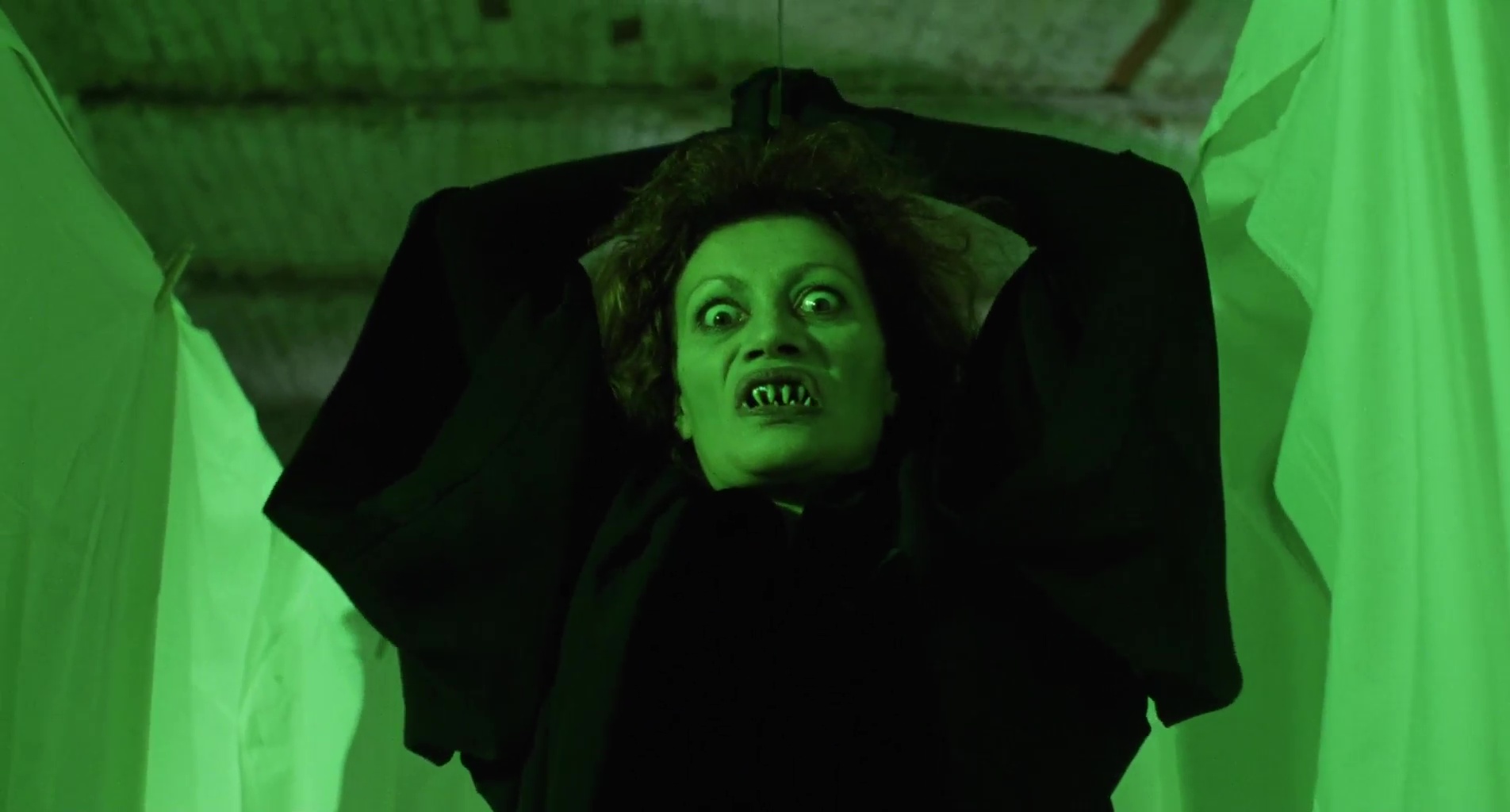
Events really kicks off when a killer resembling Faye Dunaway in Supergirl (1984) with dodgy chompers, begins dispatching various folk by drooling over them with her web drool and then fatally stabbing them. Pick of the bunch, is Maria (Claudia Muzii), a hotel maid who winds up with a knife in her skull during a stunning set piece which is obviously inspired by Suspiria thanks to the numerous on screen props and its colour palette.


Roland Wybenga's performance might come across a little wooden, especially as he lacks the emotional range of the far talented James Stewart, but the supporting cast are rather good and help compensate this issue. The best performance being played by Stéphane Audran as Mrs. Kuhn, the sinister manageress and owner of Hotel Starvas. There's also Paola Rinaldi, who is effective as Dr. Roth's assistant, Genevieve Weiss. She's great as the seductive femme fatale, having you second guessing where her allegiances really lie.

Nino Celeste's cinematography is absolutely gorgeous and major highlight of the film; the Argento-esque scenes are particularly breathtaking. Considering its low budget, the film is stunning to look at from start to finish; a stark contrast to some of the other Italian Horror films from the late eighties. Its aesthetic beauty is definitely a reason why I'm smitten by this film.


Love the Lovecraftian theme involving an ancient cult of spider worshippers known as the Weavers. This revelation instills paranoia and fear upon Whitmore, who just so happens to be an arachnophobic. For fans of horror, it's an intriguing concept which spoils us rotten with fantastic subterranean locations and a scene which borrows very heavily from Rob Bottin's legendary and unsurpassed effects work from The Thing (1982). Sergio Stivaletti's attempt at replicating Bottin comes across a Lidl equivalent, sadly. On a positive tip, that's a fairly minor issue as the rest of the effects are very good; particularly found the stop motion spider scenes very endearing as they evoked vintage Ray Harryhausen greatness.

Legitimately shocked that I had no prior knowledge of The Spider Labyrinth's existence until recently. Definitely deserves a spot as one of the best late game Italian Horror films, in my honest opinion. An absolute treat of a film. So glad it's been rescued from obscurity. Makes me wonder if there are any other lost Italian Horror gems out there awaiting discovery.