Sunday, March 31, 2024

Viewings: March 2024

Free time was a bit scarce this month. Hence, the usual obscene amount of films took a hit. Edward Dmytryk's The Sniper was the only real highlight for me.


Film:
The Sniper (Edward Dmytryk, 1952)*
The Curse of Frankenstein (Terence Fisher, 1957)
Dr. Who and the Daleks (Gordon Flemyng, 1965)
Creatures the World Forgot (Don Chaffey, 1971)*
Craze (Freddie Francis, 1974)*
Identikit AKA The Driver’s Seat (Giuseppe Patroni Griffi, 1974)*
Damage (Louis Malle, 1992)*
Tokyo Decadence (Ryû Murakami, 1992)*
Sweatshop (Stacy Davidson, 2009)*
The Iron Claw (Sean Durkin, 2023 / 2024)*
Lisa Frankenstein (Zelda Williams, 2024)*
Poor Things (Yorgos Lanthimos, 2023 / 2024)* 
Stopmotion (Robert Morgan, 2023 / 2024)*
 
Television:
Doctor Who - Various Episodes (Sydney Newman, 1963 - 2024)*
Mastermind - Episodes 27 - 30 (Bill Wright, 2023 / 2024)*

*First time viewings.


Dada Debaser Notes:

  • The NSFWish film poster for Tokyo Decadence is better than the actual film. Would have enjoyed it a lot more if it didn't make such a radical tonal shift in the second half.
  • Jack Palance as a London antiques dealer sacrificing women to an African wooden statue good called Chuku should have been an amazing film. Instead, Freddie Francis turns this bonkers concept into a police procedural. Great cast though, including Diana Dors as an amorous landlady.
  • Expected Indentikit to be for Elizabeth Taylor what The Swimmer (1968) was for Burt Lancaster. Sadly, it wasn't. This was boring, but well shot shite.
  • Really wish Stopmotion was a stop-motion feature film rather than the cliched horror that we got. Kind of pales in significance after the twisted awesomeness of Mad God (2021).
  • Watched three Frankenstein themed films; best of the bunch was Terence Fisher's film. Forgot how cold blooded and ruthless Peter Cushing was in it.

Tuesday, March 19, 2024

After Dinner Snack

Snack Shack (Trailer)
Adam Rehmeier, 2024
 

Things I realised from the latest Severin Cellar video: Director Adam Rehmeier has great taste in grindhouse films; I don't own a copy of the classic Aussie horror Patrick (1978); and lastly, Severin did a better job of letting me know about Rehmeier's new film than the marketing team over at Paramount.

Set in the summer of 1991, Snack Shack (2024) is a teen comedy inspired by Rehemeier's upbringing in Nebraska City about two young entrepreneurs and their various escapades. Hardly sounds like the type of film that scratches that itch for Dada Debaser type films, however, judging by its trailer, it's already looking better than the overrated and unfunny shite that was Bottoms from last year.

Dinner in America (Prayer Scene)
Adam Rehmeier, 2020/2021
 

Rehemeier's previous effort was Dinner in America (2020/2021); a film that can fundamentally be described as a rom-com, which wouldn't be a genre that appeals to me at all. Surprisingly, it turned out to be one of the best movies to come around my way in recent years. It's grown into a cult movie since then, with even YouTuble film bozos RedLetterMedia gushing over it with praise. Therefore, I'm eager to see how potentially great Snack Shack might be, and how it compares to Rehemeir's modern classic.

Friday, March 15, 2024

Female Trouble

The Sniper (Edward Dmytryk, 1952)

Always a surprise whenever a film from the past subverts any preconceived notions you hold for a particular era in cinema. Edward Dmytryk's chilling film noir, The Sniper (1952), is one of those types of films. Much like James Landis's The Sadist (1963) being the spiritual predecessor to films like Terence Malick's Badlands (1973) and Oliver Stone's Natural Born Killers (1997), The Sniper's Eddie Miller (Arthur Franz) comes across as a precursor to Norman Bates and Frank Zito.

Dmytryk's thriller largely focuses on its antagonist, a violent misogynist working as a dry cleaning deliverer. Miller is an ace shot with a rifle and ever since his release from a prison psychiactric ward, he's been resisting the urge to pull the trigger on various women who have crossed his path. Here's the interesting thing: he wants to be stopped.

What finally pushes him over the edge and turns him into a killer is when he's friendzoned by a bar musician, Jean Darr (Marie Windsor), who, after asking for a special favour from him regarding an emergency dry clean, scurries him out of her apartment when her boyfriend arrives. This results with one of the most disturbing moments of the film, when she's callously shot in the head after leaving her work.

There isn't a clear cut protagonist in The Sniper to counterbalance Eddie Miller's deranged killings; instead we're provided with various characters who might have played the part if they were give enough screen time. Adolphe Menjou is perhaps the closest to one, however, as the elderly Police Lt. Frank Kafka (I'm not joking). There's also a very late introduction of a young criminal psychiatrist played by Richard Kiley, who hardly gets to do much, other than reveal the film's liberal social message; intervention and reform from a young age.

Given its plot of a serial killer armed with a sniper rifle, and the fact that it's set in San Francisco, I can't help but think that The Sniper must have been an inspiration to Don Siegel's classic seventies thriller Dirty Harry (1971). Obviously, the major differences being the latter features a gigachad protector played by the legendary Clint Eastwood. It also contains a more conservative message; criticising the legal system that protects a suspected menace with its bureaucratic red tape. Dmytryk's takes a far more liberal and compassionate view in this regard.

Genuinely surprised a film with such a dark subject matter would ever be released by a Hollywood studio — particularly Columbia Pictures. What would have been more fitting as a low-budget exploitation film produced by the likes of B-movie legend, George Weiss back in the day, is a highly polished and thoroughly thrilling Stanley Kramer production. Thus, The Sniper is not only an excellent film noir, but a serial killer film which might have been ahead of its time.

Wednesday, March 13, 2024

Pisces of the Puzzle

Andre Nickatina - I'm a Pisces
Cocaine Raps album, 1997

Managed to finally solve the final piece recently in a doubly perplexing puzzle which consisted of two samples used on Andre Nickatina's rap song, I'm a Pisces.

Identifying their origins became something of an obsession ever since I first heard the song on an ancient rap forum. Had a hunch they were both sourced from films, but I was never 100% sure, however. Turns out I was right after all these years:

Bernard Herrmann - Cobra Dance
The 7th Voyage of Sinbad OST, 1958
 

Chanced upon randomly watching The 7th Voyage of Sinbad (1958) on TV many years ago and hearing Bernard Herrmann's Cobra Dance was a eureka moment. The music in question occurs during the scene where the villainous sorceror, Sokurah, melds a handmaiden in a giant clay vase with a cobra, like a progenator to the Brundlefly. With the aid of Ray Harryhausen's ace stop-motion mastery, the snake woman dances before the sultan's royal court. Knew this wasn't some obscure song from a far off continent, but taken from a vintage Hollywood film. Took some years to finally realise it, though.

Death Journey (Trailer)
Fred Williamson, 1976
 

Would have loved it if the vocal sample from the start of the song was a similar discovery to the one above, but this was a lot more straight forward - Googling! Yes, it took decades until your host realised he could do a simple Google search. Lo and behold it turned out to be from a Fred Williamson film called Death Journey (1976). The dialogue in question appears at 58 minutes and 21 seconds into the film, but you can hear a part of it in the trailer, too. Thus, the final piece in the puzzle which has antagonised the little grey cells for so long has finally been laid to rest.

Thursday, March 7, 2024

To the Devil a Trailer

Late Night With the Devil (Trailer)
Cameron Cairnes & Colin Cairnes, 2024


The Phillippou Brothers weren't the only siblings hailing from Australia with a horror film in 2023. Unfortunately, Cameron and Colin Cairnes's Late Night With the Devil (2023/2024) wound up doing the festival route while Talk to Me (2022/2023) found distribuition via wunderlabel A24 and subsequently became one of the highlights that year.

A trailer has recently been unveiled. No doubt the Cairnes Brothers are hoping for similar success with their seventies throwback to late night television. For the Brits out there, the film's premise strikes comparison with the supernatural spectacle of Ghostwatch (1992). The very reason this blipped its way on the blog's radar in the first place. 

The underrated David Dastmalchian as the late night talk show host, Jack Delroy, is a major plus as he's always been a "that guy" in his scene stealing minor roles. Dastmalchian's Polka-Dot Man was also one of the reasons The Suicide Squad (2021) proved be one of the few good comic books movies in recent years. This all makes Late Night With the Devil something of a must watch for your host, hopefully it lives up to its potential.

Tuesday, March 5, 2024

Quest for Misfire

Out of Darkness (Andrew Cumming, 2022/2024) 

Stuck for two years in the film festival quagmire, Andrew Cumming's prehistoric survival horror Out of Darkness (2022) unearths its way to the general public with a new title (PKA The Origin) and the final result is it should have stayed in the bog.

Set in 43,000 B.C, Out of Darkness begins with a small tribe landing on the shores of an undiscovered land; somewhere in ancient Europe. Tension soon replaces elation when our Paleolithic collective soon discover that they're not alone in the hostile wilderness. At first, it's the suspicious demise of a mighty beast, then it's the sounds from the darkness beyond their campfire. When one of the party is snatched into the blackness of night, the horror elements of the film really come into play.

What sells the film is its premise; this isn't just another one of those fish out of water stalk and slash type films, but one that's set in the prehistoric past, where its characters are familiar with survival. The other selling point is the unique language created for the film that's spoken by its cast. That's the good out of the way.

The problems of the film become abundantly clear with its typically modern and generic story telling. That's all well and good in your average Star Wars or MCU shite, but it's immersion breaking in a film which has taken some effort striving for authenticity with creating an ancient language. Why on Earth would a writer feel compelled to point out how awful the patriarchy is in a caveman horror thriller? Wouldn't be surprised if the writers gave themselves a pat on the back when they named two of the film's characters Adem and Avé. These eye rolling, cringe worthy faux pas would have been forgiven if Out of Darkness did not have one of the most reprehensible girl boss protagonists to ever grace a film since Odessa A'zion's Riley in Hellraiser (2022). Capping it all off, the film ends with an underwhelming final act revelation containing a glib social message en par with Robert Kerman's "I wonder who the real cannibals are" from Cannibal Holocaust (1980).

Worth noting that the Scottish Highlands look fantastic in the film and really drive home its ancient setting. It's all a huge shame as the cast are generally good, particularly Kit Young as the young Geirr. Also, I can't really hate on Safia-Oakley Green as the girl boss Beyah, either; hardly her fault her character was written so poorly. If only this film was produced around the same time of the classic subterranean horror The Descent (2006), which also contained cavemen of a sort. The film wouldn't have fallen victim to such modern day unnecessary distractions like its menstruating girl boss protagonist worrying about her toxic tribal chief stripping her of her virginity amidst the unknown entity which is stalking them.

Funny thing about Out of Darkness's general negative reception is the criticism over it containing a diverse multi-ethnic tribe, Gucci looking fur clothes and shaved faces ruining their perceptions of prehistory. None of those were an issue for me. They might very well be anachronistic (who really knows, am I right?), but they were far more tolerable than the Tumblrina levels of writing. Besides, the best caveman film is Don Chaffey's One Million Years B.C. (1966) which was blessed with the iconic Raquel Welch and dinosaurs (courtesy of the legendary Ray Harryhausen) that were already extinct when our ancestors first walked the Earth:

One Million Years B.C. (Trailer)
Don Chaffey, 1966

Thursday, February 29, 2024

Viewings: February 2024

Jonathan Glazer’s The Zone of Interest is not only the pick of the month, it’s also the highest rated film from the 2020s I've awarded since the blog’s creation. 

Other recent hightlights were Gianfranco Giagni's obscure, Italian horror gem The Spider Labyrinth and Don Medford's bitterly bleak The Hunting Party.


Film:
The Ghost Train (Walter Forde, 1941)*
The Secret Cinema (Paul Bartel, 1966/1968)*
The Hunting Party (Don Medford, 1971)*
The Werewolf Versus the Vampire Woman (León Klimovsky, 1971)*
The Crazies (George A. Romero, 1973)
Boss Ni**er (Jack Arnold, 1974)*
The Bitch (Gerry O’Hara, 1979)*
The Spider Labyrinth (Gianfranco Giagni, 1988)*
They Live (John Carpenter, 1988)
Carlito’s Way (Brian De Palma, 1993)
Self Catering (Robin Lefèvre, 1994)
Belly 2: Millionaire Boyz Club (Ivan Frank, 2008)*
Open Graves (Álvaro de Armiñán, 2009)*
Divinity (Eddie Alcazar, 2023)*
Dario Argento Panico (Simone Scafidi, 2024)*
Out of Darkness (Andrew Cumming, 2022/2024)*
Night Swim (Bryce McGuire, 2024)*
The Zone of Interest (Jonathan Glazer, 2023/2024)*

Television:
Doctor Who - Various Episodes (Sydney Newman, 1963 - 2023)*
Mastermind - Episodes 23 - 26 (Bill Wright, 2023/2024)*

*First time viewings.


Dada Debaser Notes:

  • For decades I've wondered if Richard France from The Crazies (1973) and Dawn of the Dead (1978) was the voice on the intro to Dr. Dre's Lyrical Gangbang. Still not sure.
  • Night Swim is a contender for one of the worst films released this year already. The latest example of a short film that should not have been turned into a feature length.
  • Shout out to all the blind buyers who copped the boutique blu-ray of the lo-fi, B&W, sci-fi borefest Divinty when they should have checked out LOLA instead. I did like the Kool Keith song from it, however.
  • Other than they sound completely different, you can tell another actor was used to narrate the Game's character in the awful Belly sequel as he wasn’t name dropping anyone.
  • Went film detective trying to identify a TV movie I watched back in the day where John Gordon Sinclair was cooked and eaten. Turned out to be Self Catering and still on Channel 4's website.
  • Can’t believe people risked their lives during the Blitz to watch humourless Arthur Askey comedies.
  • Nearly forty years after Opera (1987) and Cristina Marsillach is almost reduced to tears when reminiscing over her experience with Dario Argento in the latest documentary about him. Feeling the same way about Asia Argento's awful tattoos, to be honest.
  • On paper, The Werewolf Versus the Vampire Woman has all the elements I look for in a great Paul Naschy film, but it pales in comparison to its quasi-remake, The Night of the Werewolf (1981).

And finally:

Tuesday, February 27, 2024

Night School

Exploitica/Exploitica Rides Again - Curfew Breakers!
Channel 4 Television, 1999 - 2000

An unsung gem of late night TV was the short lived Channel 4 show Exploitica. In a similar vein to MST3K, the show mocked various B- Movies of the past, but with its own indelible British humour; often as problematic as the films it ridiculed.

Much like Moviedrome, Exploitica, and its second season, retitled to Exploitica Rides Again, would serve as film school for devotees of psychotronic cinema. Material was ofteen sourced from Something Weird's legendary back catalogue like The Violent Years (1956). Also, the show wasn't afraid to laugh at sacred genre cows like Deep Red (1975), either. Its lampooning of various educational/propaganda films from the past, was another reason why the show hit all the right notes for me.

Sadly, its dedicated and ancient YouTube channel appears to have even less clips available than I last visited it; maybe it's due to licensing and ownership issues. Feeling a lot like Roy Batty in Blade Runner whenever I get nostalgic over this classic late night show - all those moments will be lost in time.

Exploitica/Exploitica Rides Again - The Violent Years
Channel 4 Television, 1999 - 2000

Sunday, February 25, 2024

Nobody Beats the Riz

Having heard Riz Ortolani's theme from the very downbeat The Hunting Party (1971) for the first time recently, makes this a good opportunity to list some other joints I dig from the composer. Despite scoring soundtracks for some notorious films from the world of cinema, his music has often been a universal positive to soundtrack heads like myself.

I Giorni Dell'ira / Day of Anger (1967)

Miami / Goodbye Uncle Tom (1971)

Il Ricordo di Serena / Confessions of a Police Captain (1971)

Web of the Spider / Web of the Spider (1971)

Seven Bloodstained Orchids / Seven Bloodstained Orchids (1972)

Cyclone / Cyclone (1978)

Il Corpo di Linda / The Pyjama Girl Case (1977)*

Adulteress Punishment / Cannibal Holocaust (1980)

Roma Imperial Rock / Warriors of the Year 2072 (1984)

Riz Ortolani - Do It To Me
House on the Edge of the Park OST, 1980

Fave Ortolani cut will always be Do It To Me off  Ruggero Deodato's thoroughly mean-spirited nasty House on the Edge of the Park (1980), which was hilariously titled wrong in the film and its trailer. It's been a disco themed earworm that could have played at Fontaine Khaled's swanky London club back in the day. The song being associated with the most amusing scene from House on the Edge of the Park, before things go very sour for its uppity class party hosts, is probably another reason, too.

* Other than Il Corpo di Linda, the soundtrack to The Pyjama Girl Case is ruined by French singer Amada Lear sounding like a heavily sedated Marlene Dietrich struggling to remain conscious and in tune. If only the much preferred trailer music was included instead as it knocks, before Lear’s awful song plays near the end. No idea if Ortolani was responsible for it, though.

Friday, February 23, 2024

House of Glazer

The Zone of Interest (Jonathan Glazer, 2023/2024)

Jonathan Glazer's long awaited film, The Zone of Interest, a loose adapatation of Martin Amis's titular novel, is a powerful viewing experience. Horrific atrocities that occur in the film are largely implied, heard and viewed from afar. Therefore, much of the horror is left to our imagination. Adjacent to the unseen nighmare, we're privvy to the domestic life of  Rudolf Höss (Christian Friedel), commandant of the Auschwitz concentration camp, living next door to "the zone of interest" with his family.

Witnessing the commandant's family living with complete apathy right next to what can be best described as Hell is what makes this an incredibly powerful and chilling film. Höss isn't portrayed as some completely deranged pyschopath making it easy to differentiate from. He behaves like a normal individual towards his family; even feeling sad for his horse who he needs to leave behind due to work commitments. That's what makes this such a compelling experience; what appears like a normal individual being capable of committing monstrous actions. Two scenes which really highlight this is where he's having a mundane chat in bed with his wife, Hedwig, about a possible vacation in Italy, and it's immediably followed by a close shot of him overseeing prisoners being processed after their arrival at the death camp. The sounds are truly distressing and haunting. Not something that will be easy to forget any time soon.

Hedwig Höss (Sandra Hüller), the matriarch of the family, is also complicit with the horror. She takes extreme pride of her dream home. She even considers herself  "the Queen of Auschwitz", claiming that she would have to be dragged away the paradise she lives in. Her staff, work in abject fear. One of whom bearing the burden of Hedwig's annoyance is threatened with, "I could have my husband spread your ashes across the fields of Babice." Chilling. There are hints throughout the film that Hedwig came from poverty and is of a low class. Prisoners' personal belongings are amusingly said to come from "Canada" by Hedwig and her friends. Her callousness is spawned from the jealousy and resentment she harboured before fascism gave her and her family prosperity.

Smoke from steam engines carrying its human victims can be seen from the walled perimeter of the Höss's home. The dark and acrid smoke from the crematorium chimney can be observed both day and night. It's the final straw during a restless night for Hedwig's visiting mother. She realises that her former employer, Esther Silberman, might have suffered a horrific fate on the otherside of the wall. Ash is mixed with top soil by a prison labourer in the commandant's garden. The flowers looks beautiful. These sequences respectfully allow the audience to fill in the gaps.

Sound is integral to the film's disturbing atmosphere. Our eyes might not witness the horror, but our ears ghive some insight with what might be occuring offscreen. Barking guard dogs, crackfire from a gun and the screams of helpless people are very harrowing. The ghastly gutteral sound of furnaces at work is also unsettling. These are all ambient sounds in the background of the Hoss family dream home. What's more, it's the norm for the children. Claus the oldest son, a collector of gold teeth, has fun at the expense of his younger brother, Hans, by locking him in the greenhouse and mockingly making the sound of hissing gas. It's rather obvious, the children know exactly what is going on beyond the proximity of their grounds.

Micha Levi's soundtrack also plays a huge part. It's minimal, and otherwordly modern, but complimentary and never out of place. Glazer bravely begins the film by focusing on nothing but a black screen for a few minutes. Once the viewer begins to adjust to the cinematic depravation, a haunting choral and a strained string arrangment can be heard in the darkness. It's followed by chirping birds and other familar woodland sounds, before the opening shot of the Höss family enjoying a day out by a picturesque lake. 

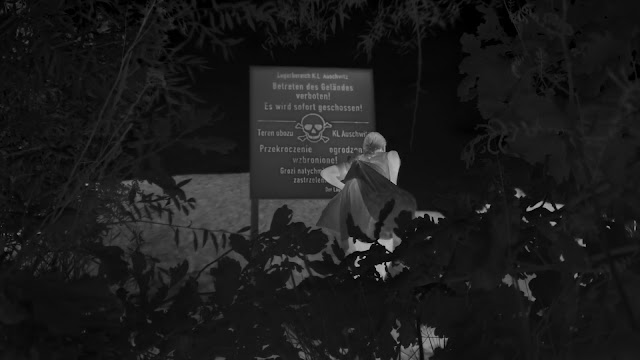
While sound plays such a large part, visually, it's a stunning looking film. For such a horrific event in history, everything looks sharp with some superb composition. High resolution close-up shots of various flora in the garden show beauty all while you're hearing the horrors past the garden wall. Another example of the contrasts Glazer utilises in the film. Certain scenes involve a young Polish girl placing apples and various other food around a construction site in the darkness of night for the starving prisoners to eat. These moments are shot with the aid of thermal vision cameras. The effect looks ultra modern and somewhat alien for a period piece, but it works remarkably well within the context of the film. 

Always annoying when all the wannabe Eberts, all-access shills, culture journos narcissists spew massive heaps of praise towards undeserving films. Words like "classic" and "masterpiece" are often unwarranted and used far too liberall. Jonathan Glazer's The Zone of Interest exemplifies these two descriptions during a time when they had real value. This is a tough and harrowing film to watch, but a supremely powerful story in modern cinema.